Get VMware 3V0-21.25 Dumps For Quick Study [2026]
Wiki Article
BONUS!!! Download part of VCE4Dumps 3V0-21.25 dumps for free: https://drive.google.com/open?id=1XB3YZSaZhRIJVXUzRRgkdesGW3ob1uTn
3V0-21.25certification exam questions have very high quality services in addition to their high quality and efficiency. If you use 3V0-21.25test prep, you will have a very enjoyable experience while improving your ability. We have always advocated customer first. If you use our 3V0-21.25 Learning Materials to achieve your goals, we will be honored. And our 3V0-21.25 pdf files give you more efficient learning efficiency and allows you to achieve the best results in a limited time. Our 3V0-21.25 pdf files are the best exam tool that you have to choose.
Our reliable 3V0-21.25 question and answers are developed by our experts who have rich experience in the fields. Constant updating of the 3V0-21.25 prep guide keeps the high accuracy of exam questions thus will help you get use the 3V0-21.25 exam quickly. During the exam, you would be familiar with the questions, which you have practiced in our 3V0-21.25 question and answers. And our 3V0-21.25 exam questions are so accurate and valid that the pass rate is high as 99% to 100%. That's the reason why most of our customers always pass 3V0-21.25 exam easily.
3V0-21.25 Reliable Study Questions - Reliable 3V0-21.25 Exam Preparation
The VCE4Dumps is one of the top-rated and trusted platforms that are committed to making the Advanced VMware Cloud Foundation 9.0 Automation (3V0-21.25) certification exam journey successful. To achieve this objective VCE4Dumps has hired a team of experienced and qualified VMware 3V0-21.25 Exam trainers. They work together and put all their expertise to maintain the top standard of Advanced VMware Cloud Foundation 9.0 Automation (3V0-21.25) practice test all the time.
VMware 3V0-21.25 Exam Syllabus Topics:
| Topic | Details |
|---|---|
| Topic 1 |
|
| Topic 2 |
|
| Topic 3 |
|
| Topic 4 |
|
| Topic 5 |
|
VMware Advanced VMware Cloud Foundation 9.0 Automation Sample Questions (Q60-Q65):
NEW QUESTION # 60
An administrator is configuring RBAC policies in VMware Cloud Foundation (VCF) Automation to delegate access across multiple clusters. The administrator must ensure that:
* Cluster lifecycle operations (e.g., scaling) can only be performed by a designated operations group.
* Security policies at the NSX project level remain restricted to network administrators' group.
Which two role assignments meet these requirements? (Choose two.)
- A. Assign the Service User role in VCF Automation to the operations group at the cluster scope.
- B. Assign the Cluster Administrator role in VCF Automation to the operations group at the cluster scope.
- C. Assign the Organization Owner role to the network administrators group at the tenant organization level.
- D. Assign the Security Administrator role in NSX to the network administrators group at the project scope.
- E. Assign the Service Viewer role in VCF Automation to the operations group at the cluster scope.
Answer: B,D
Explanation:
VCF 9.0 introduces a more granular RBAC model to support complex operational requirements. To meet the first requirement regarding cluster lifecycle management, the administrator must assign the Cluster Administrator role to the operations group. This role provides the specific permissions needed to perform actions such as scaling, patching, and modifying the configuration of Supervisor or TKG clusters. By scoping this at the cluster level (or within the project containing those clusters), the operations group is empowered to maintain the resources without having broad administrative access to other organizational settings. For the second requirement, the Security Administrator role in NSX must be assigned to the network administrators group. By scoping this to the project, the network admins can manage distributed firewall rules, gateway policies, and security profiles specific to that project's VPCs while being prevented from interfering with the compute lifecycle managed by the operations team. This separation of duties is essential for large-scale enterprise deployments to prevent unauthorized security changes or accidental cluster disruptions.
NEW QUESTION # 61
A customer requires a backup of blueprints within VMware Cloud Foundation (VCF) Automation to a third- party solution each time the blueprint is released.
What construct will satisfy the requirement?
- A. Velero service
- B. Event broker subscription
- C. CloudConfig
- D. ArgoCD service
Answer: B
Explanation:
To automate the export or backup of Blueprints (Cloud Templates) in VCF 9.0, the Event Broker Service (EBS) is the required mechanism. While Velero (Option A) is used for backing up vSphere Pods and ArgoCD (Option C) is for continuous delivery, neither is designed to "listen" for internal automation metadata changes.
By creating an Event Broker Subscription mapped to the "Blueprint Released" or "Template Version Created" topic, the administrator can trigger an action every time a developer finalizes a new version of their infrastructure code. This triggered action (typically an ABX or Orchestrator task) can then programmatically retrieve the YAML definition of the blueprint via the VCF Automation API and push it to an external third- party storage solution or a secondary Git repository for long-term archival and backup. This ensures that the organization maintains a complete, off-appliance history of its infrastructure designs, satisfying auditing and disaster recovery requirements.
NEW QUESTION # 62
An administrator clicks on Orchestrator to create a workflow in a VM Apps organization as shown.
Where would the administrator go next to enable Orchestrator?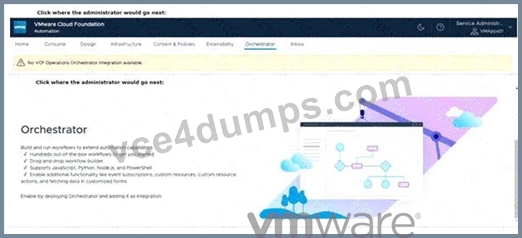
Answer:
Explanation: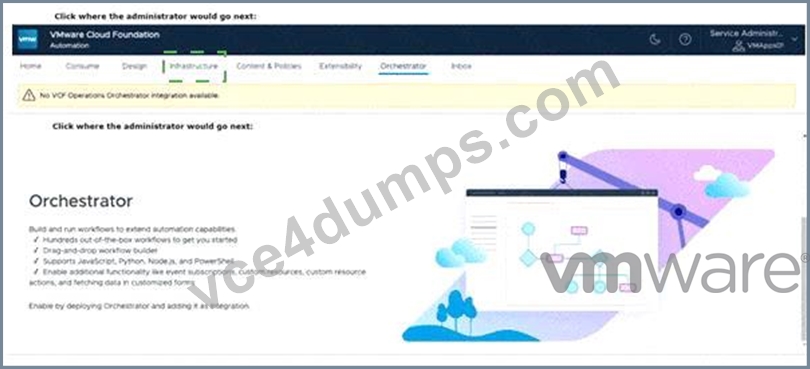
Explanation:
To enable the Orchestrator integration, the administrator must navigate to:
* Infrastructure (tab)
In VMware Cloud Foundation (VCF) 9.0, the VCF Operations Orchestrator (formerly vRealize Orchestrator) is a separate functional engine that must be explicitly integrated into the automation framework.
When an administrator selects the Orchestrator tab and encounters the warning message "No VCF Operations Orchestrator integration available," it indicates that the logical link between the Automation service and the Orchestrator appliance has not yet been established for that specific organization.
The standard administrative workflow to resolve this and enable extensibility is to move from the consumption/design view into the foundational infrastructure configuration. By clicking on the Infrastructure tab, the administrator gains access to global settings. From there, the administrator must navigate to Connections and then Integrations. Within the Integrations menu, the administrator can select "Add Integration" and specifically choose VCF Operations Orchestrator. This process requires providing the FQDN of the orchestrator server and appropriate service account credentials.
Once the integration is finalized and a successful data collection occurs, the portal's Orchestrator interface becomes functional, allowing users to build, run, and manage multi-cloud automation workflows across the VCF 9.0 fleet.
NEW QUESTION # 63
An administrator is responsible for managing a VMware Cloud Foundation (VCF)-based private cloud. The private cloud consists of a single organization with a project named production. The administrator has been tasked with ensuring that the following are standardized across all existing and new blueprints within the production project:
* Inputs: size, OS, location
* Constants: salt_master_id
Which three actions should the administrator take to meet the objective? (Choose three.)
- A. Create a new Property Group containing all constant properties for the production project.
- B. Update all blueprints within the organization to use the same locally configured inputs.
- C. Create a new Property Group containing all input properties for the production project.
- D. Create a new Property Group containing all required properties for the production project.
- E. Update all existing blueprints within the production project with the new Property Group(s).
Answer: A,C,E
Explanation:
Property Groups are the primary mechanism in VCF 9.0 Automation for achieving "reusability" and standardization across multiple cloud templates (blueprints). Instead of manually defining the same inputs or constants in every individual YAML file-which is prone to human error and difficult to update-the administrator creates a centralized group. For the requirements provided, the administrator should Create a Property Group for constants (to hold the salt_master_id) and Create a Property Group for inputs (to hold size, OS, and location). These groups are then associated with the Production Project. The final step is to Update existing blueprints to reference these property groups using the prop syntax. This ensures that if the salt_master_id ever changes, the administrator only needs to update it in one central location, and all associated deployments will automatically reflect the change, significantly reducing operational overhead and ensuring environment consistency.
NEW QUESTION # 64
A VMware Cloud Foundation (VCF) Automation administrator has been tasked with ensuring that all newly- deployed virtual machines (VMs) provisioned in the Finance Organization are automatically configured for disaster recovery protection using VMware Live Recovery (VLR). Finance is an AIIApps Organization in VCFA.
Which statement meets this requirement?
- A. Create a catalog item that calls an ABX workflow to add the VMs to VLR.
- B. Create a Day 2 action, scoped to the Finance Organization, that assigns the appropriate VLR Protection Group to all deployments.
- C. Create a Day 2 policy that adds the VMs to a VLR Protection Group. Attach the policy to all catalog items available in the Finance Organization.
- D. Configure an Event Subscription that triggers an Orchestrator workflow to protect the VMs in VLR.
Answer: C
Explanation:
In VCF 9.0, Policies are the most scalable way to enforce compliance and operational standards across an organization without modifying individual blueprints. To ensure all VMs are automatically protected by VMware Live Recovery (VLR), the administrator should Create a Day 2 policy. This policy type can be configured to automatically apply a "VLR Protection Group" assignment as a post-provisioning step. By attaching the policy to all catalog items within the Finance Organization, the administrator guarantees that regardless of which blueprint a user chooses, the protection logic is consistently applied. This "Policy-as- Code" approach is superior to manual event subscriptions (Option A) or individual catalog items (Option B) because it centralizes governance; if the protection requirements change, the admin only needs to update the single policy rather than dozens of separate scripts or subscriptions. This ensures that the Finance team's workloads remain compliant with disaster recovery mandates from the moment they are deployed.
NEW QUESTION # 65
......
With the help of 3V0-21.25 study materials, you can conduct targeted review on the topics which to be tested before the exam, and then you no longer have to worry about the problems that you may encounter a question that you are not familiar with during the exam. With 3V0-21.25 study materials, you will not need to purchase any other review materials. We have hired professional IT staff to maintain 3V0-21.25 Study Materials and our team of experts also constantly updates and renew the question bank according to changes in the syllabus. With 3V0-21.25 study materials, you can study at ease, and we will help you solve all the problems that you may encounter in the learning process.
3V0-21.25 Reliable Study Questions: https://www.vce4dumps.com/3V0-21.25-valid-torrent.html
- VMware 3V0-21.25 Actual Exam Dumps Materials are the best simulate product - www.vceengine.com ???? Search for ➡ 3V0-21.25 ️⬅️ and obtain a free download on 【 www.vceengine.com 】 ❔3V0-21.25 Book Free
- 3V0-21.25 Valid Cram Materials ???? 3V0-21.25 Test Review ⬜ 3V0-21.25 Test Review ???? Search for ➽ 3V0-21.25 ???? and download it for free immediately on 《 www.pdfvce.com 》 ????3V0-21.25 Book Free
- 100% Pass Quiz 2026 3V0-21.25: High Hit-Rate Advanced VMware Cloud Foundation 9.0 Automation Download Fee ???? Easily obtain free download of [ 3V0-21.25 ] by searching on ⏩ www.troytecdumps.com ⏪ ????New 3V0-21.25 Test Registration
- Real Advanced VMware Cloud Foundation 9.0 Automation Pass4sure Torrent - 3V0-21.25 Study Pdf - Advanced VMware Cloud Foundation 9.0 Automation Training Vce ❤ The page for free download of ➤ 3V0-21.25 ⮘ on ➠ www.pdfvce.com ???? will open immediately ⛹3V0-21.25 Test Simulator
- Reliable 3V0-21.25 Exam Pattern ↙ Latest Test 3V0-21.25 Simulations ???? Latest Test 3V0-21.25 Simulations ???? Simply search for ➡ 3V0-21.25 ️⬅️ for free download on 【 www.pdfdumps.com 】 ????3V0-21.25 Book Free
- Realistic 3V0-21.25 Download Fee: 100% Pass Quiz 2026 VMware Advanced VMware Cloud Foundation 9.0 Automation Reliable Study Questions ⚒ Easily obtain free download of “ 3V0-21.25 ” by searching on 「 www.pdfvce.com 」 ????3V0-21.25 Test Questions Vce
- VMware 3V0-21.25 Actual Exam Dumps Materials are the best simulate product - www.prepawayexam.com ???? Search for ☀ 3V0-21.25 ️☀️ and download exam materials for free through ⮆ www.prepawayexam.com ⮄ ????3V0-21.25 New Study Questions
- 3V0-21.25 Book Free ???? Valid 3V0-21.25 Practice Questions ???? 3V0-21.25 Dumps Vce ???? Easily obtain free download of ➡ 3V0-21.25 ️⬅️ by searching on ▛ www.pdfvce.com ▟ ????3V0-21.25 Book Free
- 2026 Updated 3V0-21.25 – 100% Free Download Fee | Advanced VMware Cloud Foundation 9.0 Automation Reliable Study Questions ???? Open ⏩ www.practicevce.com ⏪ and search for ▶ 3V0-21.25 ◀ to download exam materials for free ????3V0-21.25 Test Simulator
- VMware 3V0-21.25 Download Fee: Advanced VMware Cloud Foundation 9.0 Automation - Pdfvce Valuable Reliable Study Questions for you ???? Enter 「 www.pdfvce.com 」 and search for [ 3V0-21.25 ] to download for free ????3V0-21.25 Valid Exam Notes
- 100% Pass Quiz 2026 3V0-21.25: High Hit-Rate Advanced VMware Cloud Foundation 9.0 Automation Download Fee ???? Open [ www.vce4dumps.com ] enter “ 3V0-21.25 ” and obtain a free download ↔3V0-21.25 Test Simulator
- sahilfqyi402054.thenerdsblog.com, victorbgxx257092.webbuzzfeed.com, minibookmarks.com, janenpvy519194.corpfinwiki.com, zed-directory.com, ronaldzoyc274742.bimmwiki.com, redhotbookmarks.com, mariamumes309983.wikiap.com, buildnation.com.bd, directory-webs.com, Disposable vapes
P.S. Free 2026 VMware 3V0-21.25 dumps are available on Google Drive shared by VCE4Dumps: https://drive.google.com/open?id=1XB3YZSaZhRIJVXUzRRgkdesGW3ob1uTn
Report this wiki page